



Gates of Olympus 1000: A Mathematical Approach to Bankroll Optimisation
Creator:
Pragmatic Play
Type:
Slot
Variance:
Aggressive
Theoretical RTP:
96.6%
Min Bet:
0.2
Largest Bet:
100
Hands-Free Spin:
True
Release Date:
25.02.2021
This document addresses Gates of Olympus 1000 from the perspective of expected loss minimisation — the only analytically defensible strategic framework for any negative-expectation game. The phrase «winning strategy», when applied to slots, conflates two distinct concepts: short-term outcome favourability (random) and long-term return (deterministically negative). This guide concerns itself with the second, providing tools for Australian players to make informed allocation decisions consistent with their risk tolerance. No strategy alters the house edge. No strategy alters the random-number generator's output distribution. What strategy does alter is the probability that a player's bankroll survives the dispersion of a high-volatility title long enough to experience its principal events — the Free Spins round and the rare maximum-win occurrence.
In This Article
The Statistical Reality of High-Volatility Slots
Three propositions form the foundation of disciplined slot play:
- Each spin is an independent event. The random-number generator carries no memory of preceding outcomes. «Hot» streaks and «cold» streaks are post-hoc descriptions of normal variance, not predictive features.
- The published RTP — 96.50% in the default Gates of Olympus 1000 configuration — converges over millions of spins. Individual sessions exhibit dispersion that may dramatically exceed or undercut this theoretical return.
- The house edge, fixed at 3.5% under the 96.50% configuration, applies to every wagered unit cumulatively. Stake size, bet pattern, and feature-purchase decisions affect the rate at which this edge accumulates against the player, not its mathematical existence.
Common myths — that a slot is «due» for a payout after a dry sequence, that progressive betting systems can overcome the edge, that specific times of day yield higher returns — are statistically falsifiable and have been falsified in extensive third-party testing. Players are advised to discount any source advancing such claims.
Bankroll Allocation: From Theory to Practical AUD Examples
The 1-5% Per Spin Rule
The standard heuristic for high-volatility slots prescribes a stake-to-bankroll ratio between 1% and 5%. The lower bound minimises «risk of ruin» — the probability that ordinary variance exhausts the bankroll before structural events (Free Spins triggers, multiplier accumulations) occur. The upper bound permits faster session progression for players with higher risk tolerance.
| A$100 | A$1.00 per spin | A$2.00 — A$3.00 | A$5.00 |
| A$200 | A$2.00 per spin | A$4.00 — A$6.00 | A$10.00 |
| A$500 | A$5.00 per spin | A$10.00 — A$15.00 | A$25.00 |
| A$1,000 | A$10.00 per spin | A$20.00 — A$30.00 | A$50.00 |
Splitting Bankroll Across Sessions
A consolidated bankroll exposes the player to single-session catastrophic loss. Subdivision into 5-10 sessions, with each session capped at the corresponding fraction of the total, preserves optionality and constrains behavioural escalation. A player with A$500 might allocate A$100 per session across five sessions rather than committing the entire bankroll to a single sitting.
Setting Win and Loss Limits Before Play
Pre-committed limits convert variance management from in-session decision-making (subject to fatigue and emotional distortion) to a preset constraint. A frequently observed framework: end the session at +50% to +100% gain (locking realised profit) or at -50% loss (preserving 50% of session bankroll for subsequent sessions).
Hit Frequency Mathematics: Decoding 28.41%, 1-in-415, and 1-in-2.7M
Base Game: One Hit Every 3.52 Spins
The 28.41% hit frequency represents the probability that any given base-game spin produces at least one paying combination. Inverted, this means roughly one win every 3.52 spins. The distribution of these wins is heavily skewed: small wins (under 2× stake) dominate, while larger wins cluster around feature events.
Free Spins Trigger: One in Approximately 415 Spins
Pragmatic Play's published documentation and third-party analytical sources converge on a Free Spins trigger probability between 1 in 415 and 1 in 448 spins. At a typical session rate of 60 spins per hour, this corresponds to an average of one Free Spins round every 6.9 to 7.5 hours of continuous play — a meaningful planning horizon for any player intending to experience the principal feature.
Maximum Win 15,000×: One in 2,749,771
The maximum win probability of 1 in 2,749,771 spins represents an extreme tail event. For contextual scale, this is approximately 50 times rarer than the annual probability of being struck by lightning in Australia (estimated at 1 in 500,000). Strategic planning should not anticipate this outcome; it functions as a structural ceiling rather than a target.
Bonus Buy Expected Value Analysis
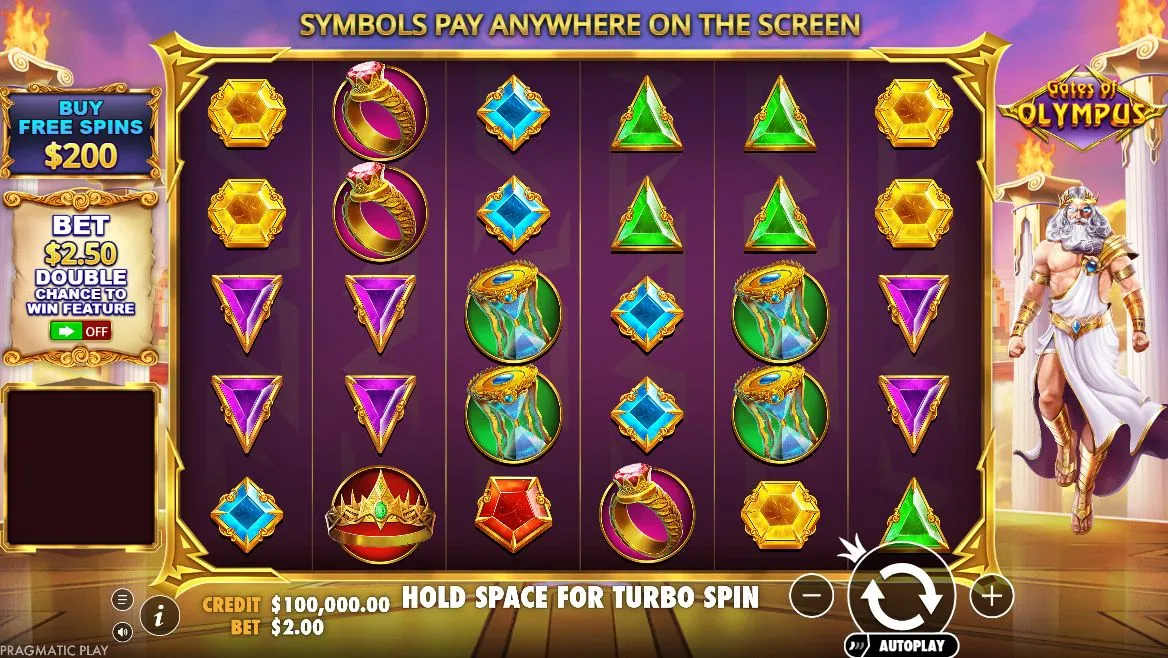
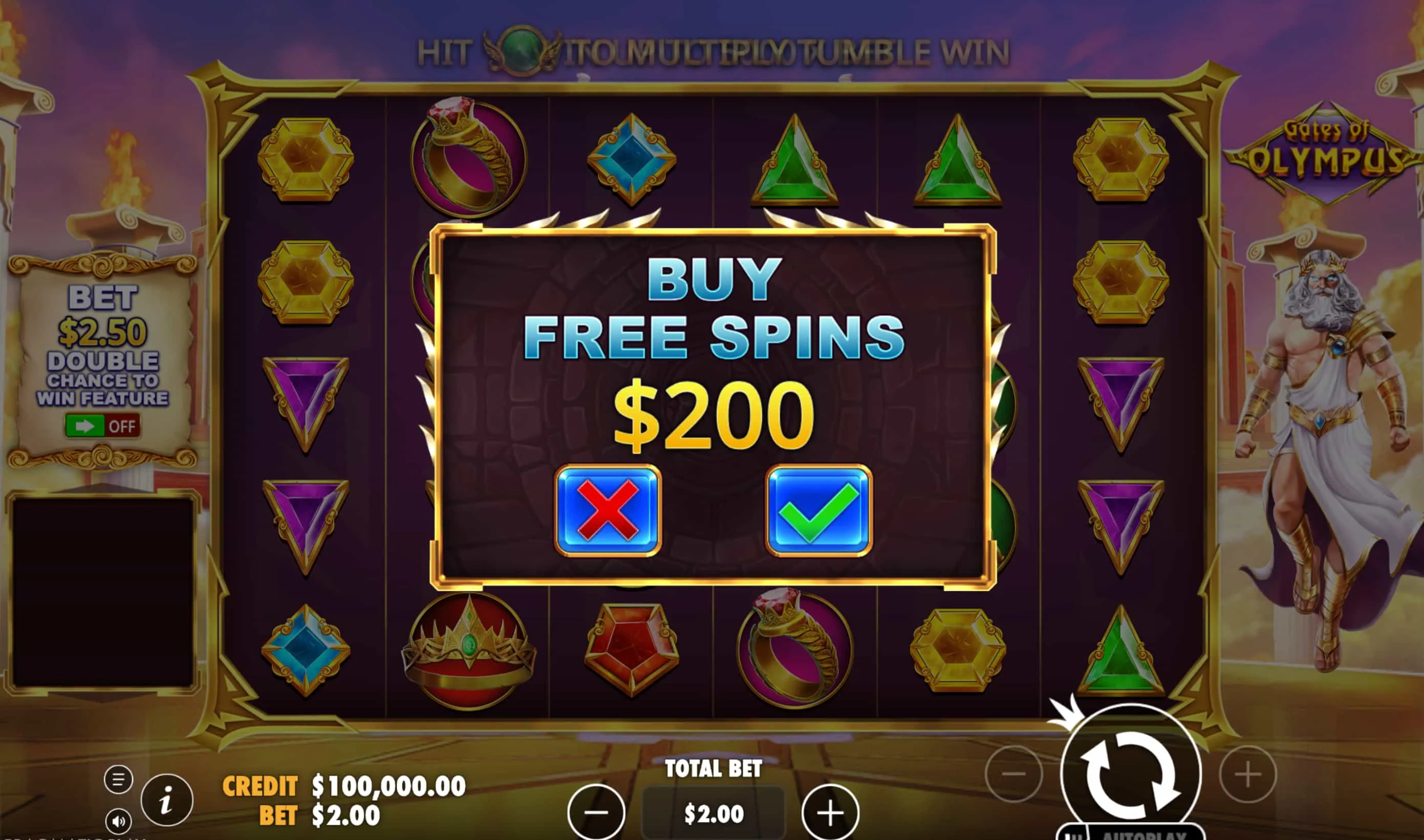
Bonus Buy permits direct purchase of the Free Spins round at a cost of 100× the current stake. The fundamental analytical question is whether this purchase improves or diminishes expected return relative to base-game accumulation toward an organic trigger.
Pragmatic Play's published RTP for purchased Free Spins rounds approximates the base-game RTP (96.50% in the default configuration). This implies that the expected value of one Bonus Buy purchase is approximately 96.5× stake — an expected loss of 3.5× per purchase. The purchase mechanism front-loads variance without altering aggregate expected return.
| Below-average round (under 50× return) | ~50% | Net loss of 50× to 100× |
| Average round (50-150× return) | ~35% | Slight gain to slight loss |
| Above-average round (150-500× return) | ~12% | Significant gain (50× — 400×) |
| Exceptional round (500-15,000×) | ~3% | Major gain |
Bonus Buy is mathematically appropriate when bankroll comfortably absorbs the 100× cost (50× cost as a recommended minimum bankroll buffer) and when the player explicitly seeks variance acceleration. It is mathematically inappropriate when employed to «recover» prior losses — a behavioural pattern with no statistical foundation.
Ante Bet: Mathematical Justification and Trade-Off Analysis
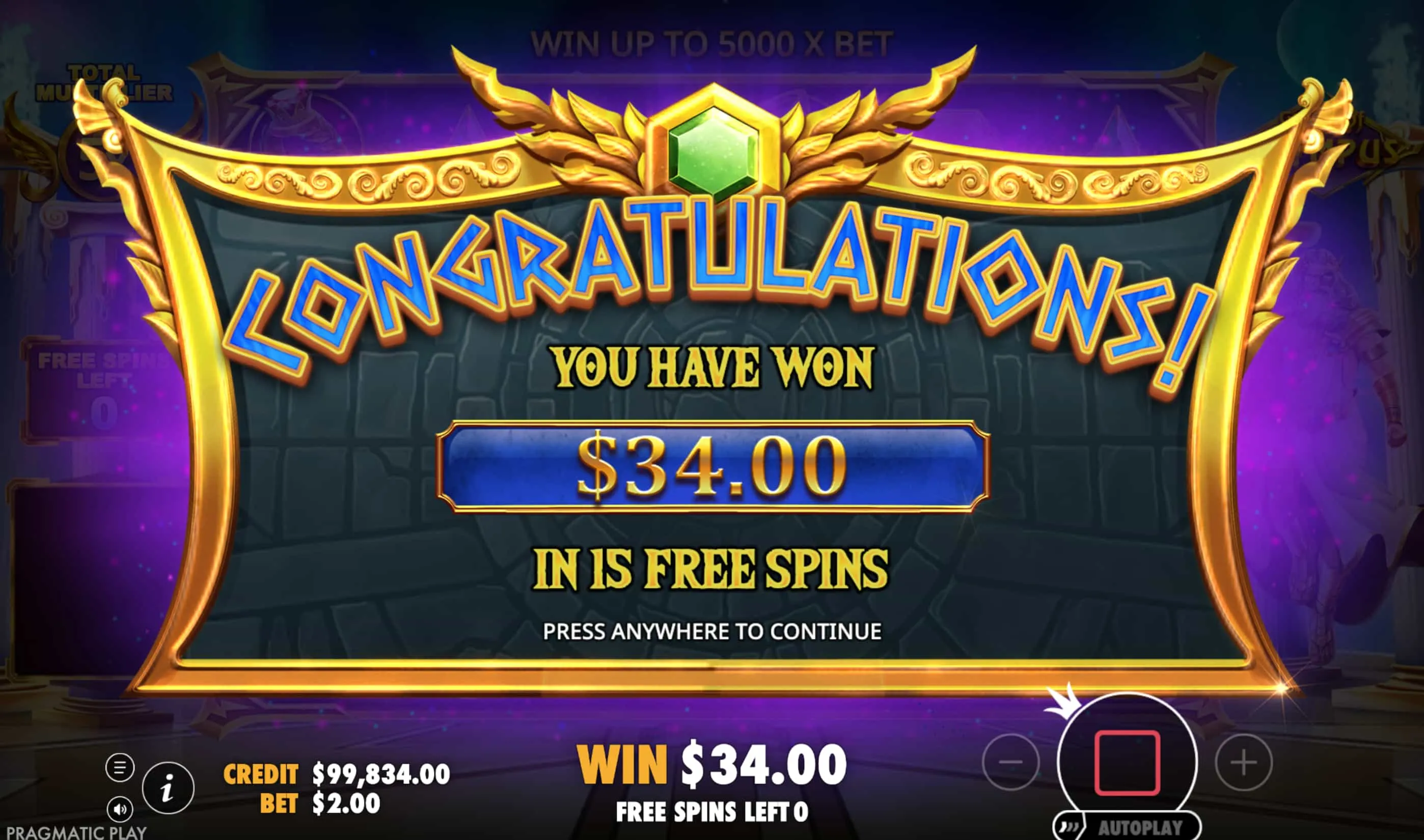
Ante Bet increases the per-spin stake by 25% and approximately doubles the Free Spins trigger probability. The analytical effect on expected cost-per-trigger:
- Standard mode: 415 spins × 1.0 stake-units = 415 stake-units expected cost per trigger.
- Ante Bet mode: 207.5 spins × 1.25 stake-units = 259.4 stake-units expected cost per trigger.
- Net efficiency gain: approximately 37.5%.
This advantage is realised only over sessions long enough for the expected trigger to occur. A 30-spin session under Ante Bet produces a 25% cost premium with negligible probability of capturing the trigger benefit. Sessions of 200+ spins approach the breakeven horizon; longer sessions accumulate the structural advantage.
| Standard | A$1.00 | A$415 |
| Ante Bet | A$1.25 | A$259 |
| Bonus Buy | A$100 (immediate) | A$100 (no variance in cost) |
Common Behavioural Patterns That Reduce Long-Term Outcomes
Pattern recognition in extended player datasets identifies the following recurring behavioural sub-optimalities:
- Loss chasing. Increasing stake size after a losing sequence to «recover» losses. Mathematically increases variance exposure without altering expected return; behaviourally accelerates bankroll exhaustion.
- Volatility misclassification. Treating Gates of Olympus 1000 as a moderate-volatility title and budgeting accordingly. The «very high» classification implies dispersion characteristics requiring a 200-500× stake bankroll buffer for stable session execution.
- Maximum-bet engagement on inadequate bankroll. Operating at the upper bet limit (A$210) on a sub-A$1,000 bankroll exhausts capital within statistical certainty.
- Bonus chasing under unrealistic wagering requirements. Engaging with welcome bonuses at 50×+ wagering without modelling the implied expected loss to clear the requirement.
- Operating under sub-optimal RTP configurations. Failing to verify operator-deployed RTP version (96.50% / 95.51% / 94.50%) and unwittingly accepting the elevated 5.5% house edge of the lowest tier.
- Disregarding pre-committed limits after wins. Continuing past a target-gain ceiling on the assumption of sustained favourable variance.
Session Boundaries: Time and Loss Limit Frameworks
Three constraint categories form the canonical boundary set:
- Time limit: 60-120 minutes maximum per session. Cognitive fatigue degrades constraint adherence beyond this window.
- Loss limit: 50% of session bankroll. Preserves capital for subsequent sessions and avoids the «doubling down» behavioural cascade.
- Win limit: +50% to +100% over starting session bankroll. Locks in realised gains in a game with no momentum-based positive expectation.
Win limits are psychologically counterintuitive — closing a session during a winning streak feels like surrendering future gains. Mathematically, however, slots possess no momentum; the expected value of the next spin remains identical regardless of session history.
Demo Phase: A Pre-Deposit Diagnostic Protocol
The demo build provides an unconstrained diagnostic environment for assessing the title's volatility signature before financial exposure. A recommended pre-deposit protocol:
- Execute 100-200 base-game spins to observe variance distribution.
- Trigger at least one Free Spins round (organically or through demo Bonus Buy) to evaluate reward distribution and animation pacing.
- Execute 1-2 Bonus Buy purchases to observe the variance distribution of purchased rounds.
- Toggle Ante Bet for a comparative segment (50-100 spins).
- Observe spin-cycle duration (approximately 3 seconds) and assess compatibility with the player's intended session pace.
This 30-45 minute protocol produces empirical confidence in the player's tolerance for the title's variance signature — confidence not obtainable from external descriptions alone.
Australian Support Resources for Responsible Play
Where the constraints described in this document — bankroll limits, session boundaries, behavioural patterns — become difficult to maintain, the following resources are available:
- Gambler's Help: 1800 858 858. Free, confidential, 24-hour availability.
- BetStop: betstop.gov.au. Australia's national self-exclusion register, applicable across all licensed operators.
- Gamblers Anonymous Australia: peer-support meetings nationally.
The transition from disciplined engagement to compulsive engagement is rarely deliberate. Periodic self-assessment against the boundary frameworks above is recommended for any player committing repeated capital to high-volatility titles.
Frequently Posed Strategic Questions
Does any strategy guarantee winnings?
No. Slots operate under a fixed, mathematically inviolable house edge. Strategy can manage variance exposure and bankroll preservation but cannot alter expected return.
What is the recommended stake-to-bankroll ratio?
Between 1% and 5% per spin for high-volatility titles. The lower bound is appropriate for capital preservation; the upper bound is appropriate only for bankrolls explicitly designated for high-variance exposure.
How frequently do Free Spins trigger?
Approximately one occurrence per 415-448 base-game spins. At 60 spins per hour, this implies one Free Spins round every 6.9-7.5 hours of continuous play.
Is Bonus Buy mathematically advantageous?
No. The expected value of a purchased Free Spins round approximates the expected value of base-game accumulation toward an organic trigger. Bonus Buy accelerates variance without improving aggregate expected return.
Should Ante Bet always be activated?
Only over sessions of sufficient length (200+ spins) to realise the trigger-cost reduction. In short sessions, the 25% stake premium accumulates without the offsetting trigger benefit.
What bankroll suits high-volatility play?
For Gates of Olympus 1000 specifically, a bankroll of 200-500× the intended stake permits stable session execution under typical variance distributions. Lower ratios increase risk-of-ruin to materially uncomfortable levels.
Statistical claims in this document derive from Pragmatic Play's published documentation and third-party analytical sources cross-verified through multiple operator deployments. Players are responsible for independent verification of operator-level configurations before financial commitment.